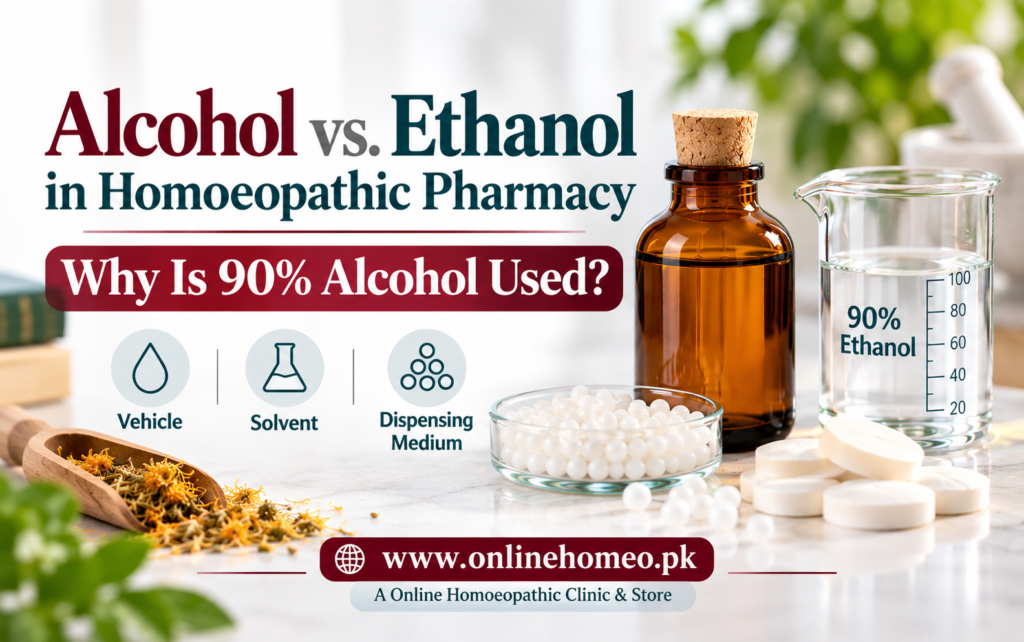
What Is the Difference and Why Is 90% Alcohol Used?
Web-ready educational article | onlinehomeo.pk
Alcohol is an important vehicle, solvent and dispensing medium in homoeopathic pharmacy. It is used in different concentrations during the preparation of mother tinctures, liquid potencies and for medicating globules and diskettes.
A common question among practitioners and students is whether alcohol and ethanol are different substances, whether ethanol is better in quality, and why 90% alcohol is commonly used in homoeopathic dispensing.
What Are Alcohol and Ethanol?
Alcohol is a broad chemical term covering a group of organic compounds. Ethanol is one particular type of alcohol.
Ethanol, also called ethyl alcohol, has the chemical formula C2H5OH. It is a clear, colourless, volatile liquid that mixes readily with water.
Ethanol = Ethyl Alcohol
In pharmaceutical terminology, when Alcohol is specified according to an official pharmacopoeial standard, it generally refers to ethanol of a defined strength, purity and specification.
It is important not to confuse ethanol with other alcohols such as methanol, which is toxic and is not a substitute for pharmaceutical ethanol.
Is There a Quality Difference Between Alcohol and Ethanol?
Not simply because of the name.
If two materials contain ethanol of the same concentration, pharmaceutical grade and purity and comply with the same specification, one is not better merely because it is labelled Ethanol rather than Alcohol.
Pharmaceutical quality depends upon identity, concentration, purity, pharmaceutical grade, impurity limits and pharmacopoeial compliance.
So, rather than asking whether alcohol or ethanol is better, the more appropriate question is whether the ethanol being used is pharmaceutical grade and of the correct strength for its intended purpose.
Why Is Alcohol Used in Homoeopathic Pharmacy?
Alcohol has several properties that make it useful in homoeopathic pharmaceutical preparations.
It acts as a solvent for appropriate starting materials, serves as a vehicle for liquid preparations and is used in specified concentrations during the preparation of certain mother tinctures and liquid potencies.
Its preservative properties are another advantage for suitable liquid preparations.
Different stages of homoeopathic pharmaceutical preparation may require different alcohol concentrations. Therefore, one alcohol strength should not automatically be considered suitable for every preparation.
Why Is 90% Alcohol Used in Homoeopathic Pharmacy?
Approximately 90% alcohol (ethanol) is particularly useful in routine homoeopathic dispensing because of its high ethanol content, relatively low water content and rapid evaporation.
One of its most practical applications is the medication of homoeopathic globules and diskettes.
- Easy dispensing: Liquid potencies in high-strength alcohol can be conveniently applied to globules and diskettes.
- Rapid evaporation: Alcohol evaporates readily after medication, making the dispensing process convenient.
- Less residual moisture: Because 90% alcohol contains comparatively little water, it leaves less moisture on sugar-based dispensing vehicles.
- Helps maintain globule quality: Reduced moisture helps minimize excessive wetting, softening and sticking of globules.
- Suitable pharmaceutical vehicle: Pharmaceutical-grade ethanol provides a convenient medium for appropriate liquid homoeopathic potencies.
- Preservative advantage: High ethanol concentrations also inhibit the growth of many microorganisms in suitable preparations.
Key point: 90% alcohol is particularly convenient in homoeopathic dispensing because it can readily medicate globules and diskettes and then evaporate rapidly, leaving comparatively little residual moisture.
Does Every Homoeopathic Medicine Require 90% Alcohol?
No.
The appropriate alcohol concentration depends on its purpose. Mother tincture extraction, preparation of stocks, potentisation, storage and final dispensing may require different ethanol-water concentrations according to the relevant pharmacopoeial procedure.
Therefore, 90% alcohol should not be described as universally superior to 60%, 70%, 96% or another specified strength.
Concentration and quality are not the same thing.
90% Alcohol vs. 96% Ethanol
Both contain the same chemical substance – ethanol.
The difference is primarily their concentration: 90% ethanol contains more water than 96% ethanol.
This difference can affect evaporation, solvent characteristics and suitability for a particular pharmaceutical process, but it does not make them different types of alcohol.
Conclusion
Ethanol and ethyl alcohol are the same chemical substance. The word alcohol has a broader chemical meaning, although in pharmaceutical practice it commonly refers to ethanol when defined by the relevant specification.
In homoeopathic pharmacy, alcohol is valuable as a vehicle, solvent and dispensing medium. High-strength alcohol such as 90% ethanol is particularly convenient for medicating globules and diskettes because of its rapid evaporation and relatively low water content.
The quality of alcohol should ultimately be judged by its pharmaceutical grade, purity, concentration and pharmacopoeial compliance – not simply by whether it is labelled Alcohol or Ethanol.
References
- United States Pharmacopeia (USP-NF) – Alcohol (Ethanol/Ethyl Alcohol) monograph.
- European Pharmacopoeia / EDQM – Homoeopathic preparations and methods of preparation using prescribed ethanol concentrations.
- World Health Organization (WHO) – Pharmaceutical excipient quality requirements and control of impurities in ethanol.