If you’ve ever picked up a small white pill from a pharmacy shelf labeled “30C” or “200C,” you’ve encountered homoeopathy — a system of medicine that’s been practiced for over two centuries, yet remains widely misunderstood. Some people swear by it. Others dismiss it outright. The truth, as usual, sits somewhere more interesting than either extreme.
A Quick History
Homoeopathy was developed in the 1790s by a German physician named Samuel Hahnemann, who grew frustrated with the harsh medical practices of his time — bloodletting, mercury, and other treatments that often did more harm than good. Hahnemann proposed a different idea: that a substance capable of producing certain symptoms in a healthy person could, in a highly diluted form, help treat similar symptoms in someone who was sick. He called this the principle of “like cures like.”
Over time, this developed into a full system involving remedies prepared through repeated dilution and vigorous shaking — a process called potentization. Today, homoeopathy is practiced worldwide, including a well-established regulatory framework here in Pakistan under the National Council for Homoeopathy and DRAP.
How Homoeopathic Remedies Are Made
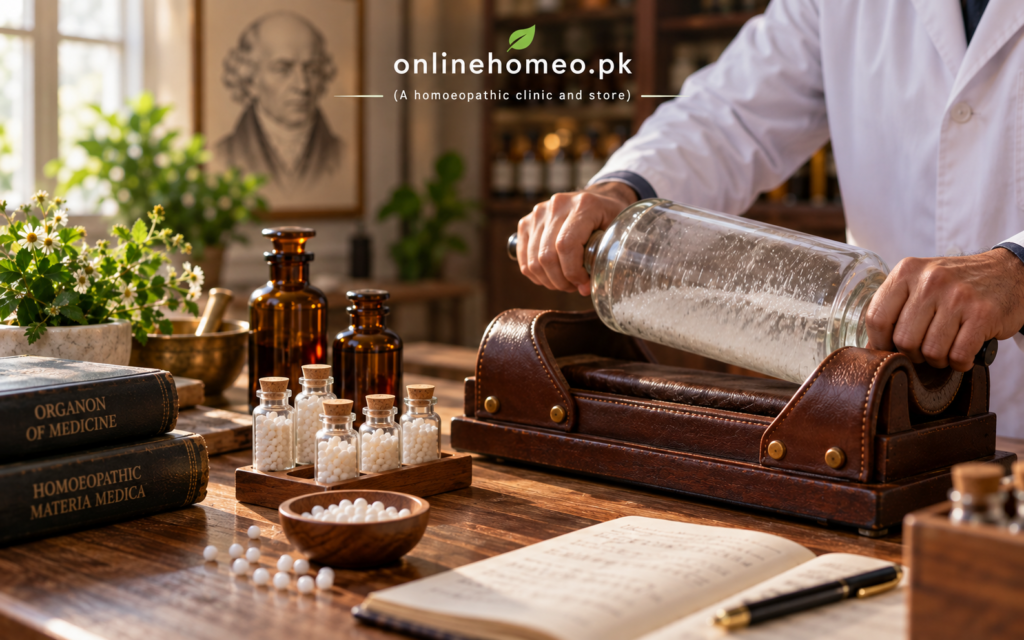
Homoeopathic remedies typically start from a plant, mineral, or animal-derived substance, which is then diluted in a solvent (usually water or alcohol) in specific ratios — often written as 6C, 30C, or 200C, referring to the number and scale of dilutions performed. Between each dilution, the mixture is vigorously shaken, a step homoeopaths call succussion.
At higher dilutions, remedies may contain vanishingly small amounts of the original substance — which is exactly where an interesting scientific conversation begins.
What Does the Evidence Say?
Homoeopathy is a topic where scientific opinion and patient experience don’t always align neatly. Large-scale reviews by health bodies in countries like Australia and the UK have generally not found homoeopathic remedies to outperform placebo in controlled trials, and the idea that extreme dilution retains a therapeutic effect remains difficult to reconcile with current chemistry. At the same time, many patients report real, meaningful improvement — and there’s genuine debate about how much of that comes from the remedy itself, the depth of the consultation, or the body’s own healing process. A thoughtful practitioner treats this as an open question worth discussing honestly with patients, rather than a settled argument in either direction.
What’s rarely disputed is homoeopathy’s strong safety profile — precisely because remedies are so diluted, serious adverse effects are uncommon. This is part of why it remains a popular choice for managing everyday, self-limiting complaints.
What Homoeopathy Is Commonly Used For
In practice, people most often turn to homoeopathy for:
- Minor, recurring complaints (seasonal allergies, mild digestive upset, common colds)
- Chronic conditions where conventional treatment has plateaued, used alongside — not instead of — medical care
- General constitutional support, addressing lifestyle, temperament, and overall wellbeing rather than a single symptom in isolation
It is not a substitute for emergency care, surgery, infections requiring antibiotics, or serious diagnosed conditions like cancer or heart disease. Any registered, ethical practitioner will tell you the same.
Homoeopathic Qualifications: DHMS vs. BHMS
Not all homoeopathic practitioners are trained the same way, and it’s worth understanding the difference:
- DHMS (Diploma in Homoeopathic Medicine and Surgery) — a diploma-level qualification, historically the more common route into homoeopathic practice, focused primarily on homoeopathic materia medica, repertory, and case-taking.
- BHMS (Bachelor of Homoeopathic Medicine and Surgery) — a full undergraduate degree, typically 4-5 years, offered by recognized universities. Alongside homoeopathic principles, the curriculum includes anatomy, physiology, pathology, and pharmacology — giving graduates a broader grounding in conventional medical sciences as well.
Both qualifications, when obtained from recognized institutions and followed by registration with the National Council for Homoeopathy, allow a practitioner to legally practice as a Registered Homoeopathic Medical Practitioner (RHMP) in Pakistan. When evaluating a practitioner’s credentials, it’s reasonable to ask which qualification they hold and confirm their registration status — a legitimate practitioner will have no hesitation sharing this.
How to Choose a Homoeopathic Practitioner
Because homoeopathy is loosely regulated in many countries, quality varies enormously. Look for:
- Registration — confirm they hold a DHMS or BHMS qualification and are registered with the National Council for Homoeopathy (a valid RHMP status)
- A proper case-taking process — a thorough consultation covering your full history, not just a five-minute symptom checklist
- Transparency about limitations — a practitioner who tells you when homoeopathy isn’t appropriate, and refers you onward, is more trustworthy than one who claims it treats everything
- Pharmacopoeial-standard remedies — sourced and manufactured to recognized standards (HPI, HPUS, GHP), not unregulated or unverified products
The Bottom Line
Homoeopathy sits in a genuinely thoughtful space in modern medicine — embraced by millions of patients worldwide, while inviting ongoing scientific discussion about how it works. That doesn’t make it a miracle cure, and it doesn’t make it worthless either. Used thoughtfully, alongside conventional medicine rather than as a replacement for it, and under the care of a properly registered practitioner, it can be one reasonable part of a broader approach to health — as long as expectations are realistic and serious conditions are never left untreated by evidence-based care.
If you’re considering homoeopathic treatment, the most important step is the same one that matters in any healthcare decision: find a qualified, honest practitioner, ask questions, and stay engaged with your regular doctor for anything serious.